Custom Runs: What a Manufacturer Needs From a Buyer
A custom cable run is only as good as the information that reaches the extruder. KUKA CABLE states that customised services are part of its offer, and it has the machinery to back that up: a wire harness processing base established in June 2021, a PV division operating independently since August 2018, and a laboratory established in December 2015 for the testing that follows.
Key takeaways
- The manufacturer offers customised services and free samples, and runs a wire harness processing base established in June 2021.
- The published range includes H1Z2Z2-K and PV1-F solar cable, UL 4703 solar PV wire, twin-core cable, connectors and PV cable assemblies.
- Published colours are black or red, and the conductor is tinned copper at class 5 to IEC 60228.
- MOQ, unit prices and lead times are not published, so a custom brief should ask for them in writing.
Start with the size and the standard, in that order
Every custom conversation begins with two facts: the cross-section and the standard the finished item must satisfy. A solar cable manufacturer can only build and test against what the brief states, so both facts have to be in the first message rather than the last. The published common sizes are 4 mm², 6 mm² and 10 mm², and the manufacturer's table runs from 1.5 mm² at 34 g/m up to 240 mm² at 2,350 g/m, so a wide range is available before anything becomes special. Ordering outside the table is where a custom run begins.
Standard comes second because it decides the compound. The published construction is XLPO insulation and sheath, electron-beam cross-linked and LSHF, over tinned copper of class 5 to IEC 60228. A buyer who needs a different compound or a different colour is asking for a genuine variation, and should say so explicitly rather than leave it to be inferred from a part number.
Say what the cable will do, not just what it is
A manufacturer can build to a drawing, but it can only test to a requirement. Telling the factory that the run will sit in a duct under a coastal car park gives the engineer something to work with: the water resistance test and the AD8 waterproofing rating become relevant, and the tinned conductor stops being a default and becomes a decision.
The published test list is the menu to choose from: water resistance, UV accelerated weathering, abrasion, cold bending, cold elongation, tensile testing after ageing, solderability, static flexibility, and construction and dimensional testing. A custom brief that names three of those tests from the start is easier to quote than one that names none.
Assembly work needs a drawing, a quantity and a delivery pattern
Connectors and assemblies move a project from cable to finished part. The published family includes MC4 and solar connectors, solar fuse connectors, solar diode connectors, PV cable assemblies and solar branch cable, and the connector page carries a CE and RoHS certificate download. The wire harness processing base established in June 2021 is the published capability behind that work.
Three items must arrive with the drawing. The first is the quantity, including any spares, because a harness run is set up once and the setup has value only if the quantity justifies it. The second is the delivery pattern, since splitting a run across several shipments changes both handling and drum sizes. The third is the test or inspection the assembly must pass — the manufacturer publishes 100% inspection of finished products for electrical, mechanical and environmental performance, and a custom assembly should be told which of those applies.
Two smaller fields are easy to forget and awkward to fix later. Packaging belongs on the brief: a drum that is right for a crane may be wrong for a van, and a coil that suits a courier may not survive a pallet stack. Identification belongs there too, because a labelled harness with a string number is a different product from the same harness in an unmarked bag, and only one of them can be traced on site.
The briefing sheet
Most delays in a custom run come from a question nobody asked in week one. The table below lists the fields a briefing sheet should carry, with the published basis for each.
| Field on the brief | Why the manufacturer needs it | Published basis |
|---|---|---|
| Cross-section and length | Sets the drum, the weight and the price basis | Table from 1.5 mm² at 34 g/m to 240 mm² at 2,350 g/m |
| Standard to meet | Decides the compound and the test set | TUV 2PfG 1169/08.2007, EN 50618:2014, IEC 62930 |
| Colour and core count | Single-core and twin-core are different builds | Black or red; twin-core cable in the range |
| Environment | Points to the tests that matter | Water resistance, UV weathering, cold bending, abrasion |
| Assembly drawing | Defines the connector and the crimp | MC4 and solar connectors, fuse and diode types, PV assemblies |
| Commercial terms | Not published, so must be quoted | MOQ, unit prices and lead times absent from the site |
Worked example: sizing a bespoke drum order
Suppose the brief asks for 3,000 m of 6 mm² cable in black. The published weight is 78 g/m, so the cable alone comes to about 234 kg (my own multiplication of the published weight by the assumed length). Spread over three shipments of 1,000 m each, that is roughly 78 kg of cable per shipment before the drum is added — a weight one person can move on a pallet but not by hand (my own arithmetic, using the published figure).
Now suppose the same brief switches to 10 mm². The published weight rises to 130 g/m, which takes 3,000 m to about 390 kg (my own calculation from the published table). The length did not change, the handling did. That is the arithmetic that makes a delivery pattern worth agreeing before the run starts.
The reach figure, and what it does not prove
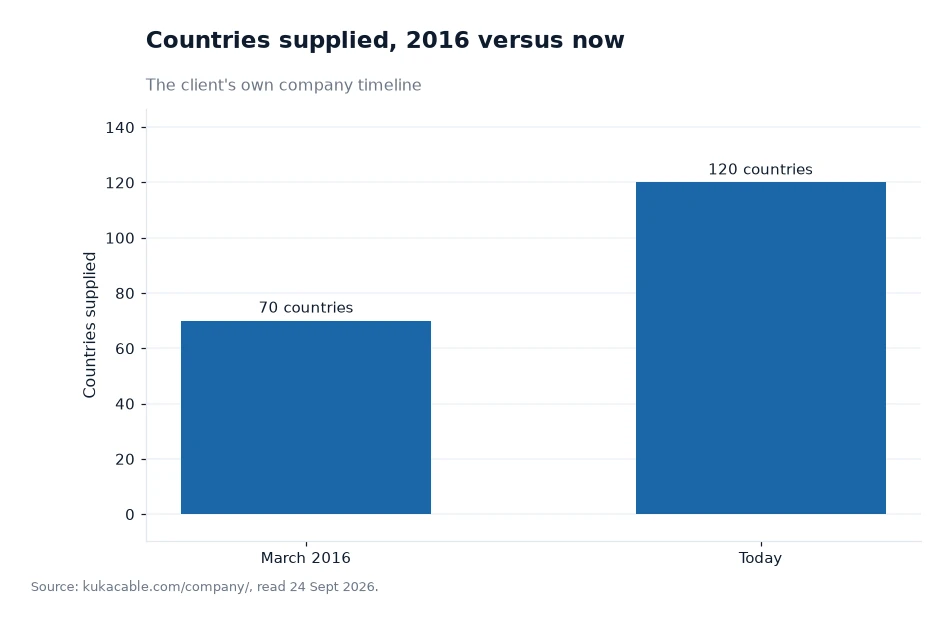
The chart below is the client's own company timeline, showing countries supplied in March 2016 against today. The published values are 70 and 120. It is included as background for a custom enquiry: a supplier that has moved from 70 markets to more than 120 has handled a variety of national requirements, which is useful context when you are the one adding a new one.
Frequently asked questions
What is the minimum order for a custom run?
The site does not publish an MOQ. That number is part of the quotation, so it should be requested explicitly in the first written enquiry rather than inferred from a product page.
Can a custom run be sampled before the full quantity?
The manufacturer states that free samples are offered on its product pages, and it publishes a customised services page. Whether a specific bespoke build can be sampled first is a question for the sales contact.
How to send a brief that comes back answered
Put the cross-section, the standard, the colour, the core count, the environment, the assembly drawing, the quantity and the delivery split on one page. Add the tests you want covered from the published list, and mark the commercial terms as questions rather than assumptions. Address it to the product consultant named on the reply, because the company describes a one-stop butler service in which a single consultant stays responsible from enquiry through delivery to post-maintenance. Keep a copy of the customised services page and the cross-section table with the brief, so the weights and sizes quoted back to you can be checked against the manufacturer's own published figures before the first drum is built.
Figures on custom runs above belong to the manufacturer's own web pages; the country and timeline data were extracted 24 Sept 2026[1].