A scent museum visit and a perfumery course are often funded from the same discretionary budget, and they are not the same purchase. The visit buys shared experience: a team that has smelled a wide range of materials and references can hold a briefing conversation it could not hold before. The course buys a skill, and a skill only returns value if someone is going to use it repeatedly. Established beauty brands tend to under-budget the first and over-buy the second, then wonder why the capability did not stay in the building. The breakdown below separates the two so that each can be judged on its own return.
Key takeaways
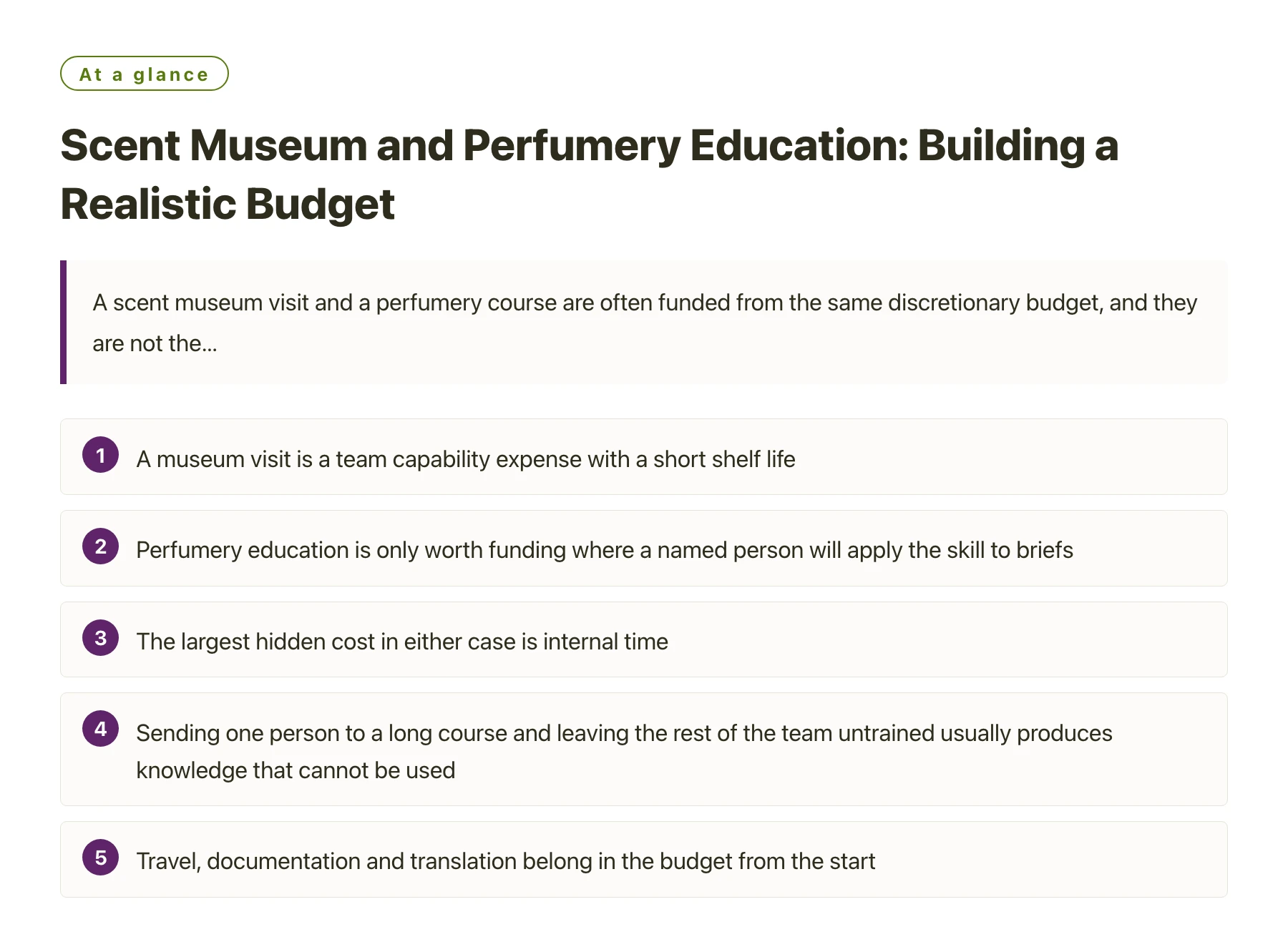
- A museum visit is a team capability expense with a short shelf life; it works when it is tied to a live project rather than scheduled as general development.
- Perfumery education is only worth funding where a named person will apply the skill to briefs, sample evaluations or supplier conversations within a few months.
- The largest hidden cost in either case is internal time, not the fee, and that time is what makes the difference between a remembered day out and a changed process.
- Sending one person to a long course and leaving the rest of the team untrained usually produces knowledge that cannot be used, because briefing is a shared activity.
- Travel, documentation and translation belong in the budget from the start; treating them as incidentals is how these programmes end up quietly cancelled.
- The right size of programme is the smallest one that changes how the next brief is written, which for most established brands is a mixed group rather than the whole department.
Capability budgets are among the first things cut and the last things measured. That is a reasonable response to programmes that produce a nice afternoon and no lasting change, and an unreasonable response to programmes that fix a specific bottleneck in how a brand talks about scent.
This breakdown is written for the person inside an established beauty brand who owns that budget and has to justify it. It splits the spend into three parts that behave differently: the visit itself, structured education, and the internal time that both require. Each part has a different justification, a different failure mode and a different way of being kept proportionate.
Two facts shape the arithmetic. First, the fragrance industry is unusual in that scent literacy cannot be acquired by reading; it requires repeated exposure. Second, a brand team's scent vocabulary is usually thinner than it believes, which is why the first session often produces more value than the fifth.
The cost breakdown, line by line
| Cost line | What it actually covers | What pushes it up | How to keep it proportionate |
|---|---|---|---|
| Visit or programme fee | Access to a collection, a guided session, or an exhibition built around materials and history | Bespoke sessions, private access, and short notice | Attach the visit to a project that is already funded, so the cost sits inside that project rather than beside it |
| Travel and time away | Flights, accommodation and the working days lost while the team is off site | Sending a large group, or scheduling during a launch window | Send the people who write or approve briefs, and schedule in a quiet period |
| Course or masterclass fee | Structured teaching, materials, and usually assessment or a project | Long-format programmes and one-to-one teaching | Fund the format that matches the number of times the skill will be used in the next year |
| Materials and lab time | The physical materials a participant works with while learning | Open-ended exploration without a defined outcome | Tie the practical work to a live brief so the materials produce something usable |
| Internal application time | The hours a trained person spends applying the skill to real briefs and sample rounds | Not budgeting it at all | Name the projects where the skill will be used before the training is booked |
| Follow-up and reinforcement | Repeated exposure after the programme, when most retention is lost | Treating the programme as a one-off event | Plan a second touchpoint, even a short one, within a few months |
The pattern is that the fee is the smallest and most visible number, while the internal time is the largest and the one nobody writes down. A brand that budgets only the fee will approve the programme and then fail to release the people who need it. If the plan includes a visit to a a museum built around smell, the same logic applies with one addition: the visit is more valuable when it is paired with a conversation about the brand's own range, because the comparison is what turns exposure into judgement.
Two purchases, two different justifications
A visit to a scent collection is best justified as briefing improvement. The measurable change is not that the team knows more about materials; it is that a brief can name a territory precisely enough that a manufacturer does not have to guess. That is worth real money, because every ambiguous brief costs a sample round.
Structured perfumery education is justified differently, and more narrowly. It pays back where one or two people are going to evaluate samples, challenge a supplier's claim or write specifications repeatedly. Where the skill will be used twice a year, a short masterclass is usually enough and a long programme is not.
Both sit inside a wider training sequence. A brand team that is building scent capability from a low base is better served by a staged path than by one expensive event, and the sequencing matters more than the level of the course; looking at how Xuelei perfumery courses are structured is a reasonable way to judge what such a path should contain.
Make the museum visit earn its place
The failure mode of a museum visit is that it becomes a reward. That is not a criticism of the visit; it is a criticism of the framing. A collection of historical and material references becomes useful when the team arrives with a specific question, walks through it with that question in mind, and leaves with a short written comparison to the brand's own range.
A scent museum is also unusual as a venue because smell is notoriously difficult to exhibit. That difficulty is itself instructive: it forces a team to notice how a scent is framed, sequenced and explained, which is the same problem the brand faces when it describes its own products. Whether the venue is an independent institution or the exhibition space of the company behind the factory, the return comes from the comparison the team makes afterwards. Museums working on this problem operate within a professional framework that has been developed over decades, and the guidance published by the international museum community is a useful reminder of how much deliberate design sits behind an experience that looks effortless [1].
Decide who goes, and how many
For an established beauty brand, the highest-return group is usually mixed and small: whoever writes the brief, whoever approves the samples, and whoever signs the purchase order. Sending only the creative side produces beautiful language that the buyer cannot cost. Sending only the commercial side produces a specification nobody can smell.
Where a brand is funding formal courses, the professional bodies that represent fragrance education are worth consulting for context on what a curriculum is expected to contain and how it is assessed, because programme quality varies much more than fee levels do [2]. The same applies to visitor-facing programmes, where the museum sector's own research on what audiences retain is a reasonable proxy for what a brand team will take back to the office [3].
One rule keeps both purchases honest: book them against a live project. A visit scheduled three weeks before a brief is written changes the brief. A course taken by someone who has two sample rounds ahead of them changes the rounds. The same programmes taken as general development rarely change anything, which is why capability budgets get cut. Xuelei runs a scent museum in Guangzhou that the company describes as the largest of its kind, and it also runs a perfumery academy that describes courses and masterclasses developed with ISIPCA; both are examples of the two purchases this breakdown separates, and neither substitutes for the other.
Sources
- ICOM — International Council of Museums —— The international organisation representing museums; publishes the ICOM museum definition and professional standards for museum practice.
- The Fragrance Foundation —— A non-profit organisation for the fragrance industry, running perfumery education programmes and industry recognition.
- Museums Association —— A professional body for museums, publishing guidance and research on museum practice and visitor experience.
Frequently asked questions
Is a scent museum visit worth funding for an established brand team?
It is worth funding when it is attached to a live brief and a small mixed group attends. The return is a shared vocabulary and a more precise brief, not general cultural development, and it should be judged on whether the next brief improves.
How do we decide between a short masterclass and a longer perfumery programme?
Match the format to how often the skill will be used. A short masterclass suits a team that evaluates samples occasionally; a longer programme suits one or two people who will write specifications and challenge supplier claims repeatedly.
What is usually missing from these budgets?
Internal time. Travel and fees are visible and tend to be covered, while the working hours needed to apply the skill are not budgeted, so the training happens and the application does not.
Should the whole team attend?
Rarely. A small mixed group that covers briefing, approval and purchasing produces more change than a large group drawn from one function, because the value comes from the conversation between those roles afterwards.
How soon should the investment show a result?
Within the next development cycle. If the trained person has not applied the skill to a real brief or sample assessment within a few months, retention drops sharply and the programme is unlikely to change anything.