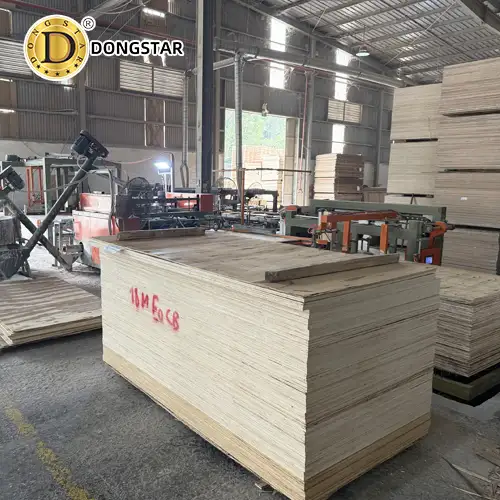
Vietnam plywood is commonly bonded with UF, MUF, PF, or lower-emission adhesive systems, and each option suits a different moisture level, market, and price range. UF works mainly for dry interiors, while MUF provides stronger moisture resistance for furniture, cabinetry, and commercial panels. PF is widely used where exterior exposure or repeated wetting is expected. For U.S. hardwood plywood, TSCA Title VI limits formaldehyde emissions to 0.05 ppm; European E1 classification is associated with a chamber concentration of no more than 0.1 ppm under EN 717-1. Buyers should specify resin type, bonding test, emission requirement, and intended use rather than purchasing by the words “MR” or “WBP” alone.
Glue selection starts with the service environment because plywood bonds do not face the same exposure in a bedroom cabinet, shipping crate, concrete-form panel, or exterior structure. ISO 12465:2007 separates plywood applications into dry, tropical dry/humid, and high-humidity/exterior conditions, while ISO 12466-2:2007 sets bonding-quality requirements for plywood bonded with thermosetting resins according to intended use. Both standards remain useful references when a buyer wants a measurable specification rather than a factory trade name.
UF, or urea-formaldehyde, is usually the lowest-cost mainstream option for interior plywood. It cures quickly, produces a relatively pale glue line, and works well for panels that remain dry during their service life, including wardrobes, shelving, decorative furniture parts, interior partitions, and some packaging.
Its limitation appears when moisture becomes frequent. Conventional UF bonds are less resistant to prolonged water exposure than MUF or PF systems, so a panel can show glue-line weakening or veneer separation after repeated wetting even when its dry bond initially looks satisfactory. In a specification written for 2026 purchasing, UF should therefore be paired with a defined indoor-use condition and an emission requirement rather than described only as “interior glue.”
MUF, or melamine-urea-formaldehyde, adds melamine chemistry to a urea-based resin system and is commonly selected when a buyer needs more moisture resistance than standard UF can provide. The exact performance is not fixed by the letters “MUF,” because resin formulation, melamine proportion, hardener, glue spread, veneer moisture, press temperature, and press time can vary from one production line to another.
That variation explains why two panels both sold as MUF plywood may perform differently after water exposure. A buyer purchasing 1 container or 50 containers should therefore ask for the bonding requirement and test method applied to finished production, not only the adhesive name.
| Glue system | Typical use | Moisture exposure | Common purchasing concern |
|---|---|---|---|
| UF | Indoor furniture, shelving, dry packaging | Low | Formaldehyde level and dry-use limitation |
| MUF | Cabinets, furniture, commercial plywood | Low to moderate | Formulation and verified bond performance |
| PF | Construction, exterior and repeated-moisture applications | High | Pressing quality and bond test |
| NAF/alternative systems | Selected interior or low-emission products | Depends on formulation | Certification, availability and cost |
PF, or phenol-formaldehyde, is used when water resistance has more weight than a light glue-line appearance or the lowest possible production cost. Phenolic adhesives have a long history in plywood manufacturing because properly cured PF bonds tolerate weather and moisture better than conventional UF systems; technical literature continues to identify PF, UF, and MUF among the major plywood adhesive families.
PF normally produces a dark brown or black bond line between veneers. That appearance can help during visual inspection, but color is not a substitute for bond testing: pigments, resin formulations, and manufacturing conditions can all affect appearance.
“WBP” needs similar care. In plywood trading, the term is often used for panels intended to tolerate boiling-water or demanding wet conditions, but WBP is not the chemical name of one resin. A quotation saying “WBP glue” gives less information than a statement identifying PF or another resin system together with a specified test procedure.
European bonding specifications provide a better framework for communication. BS EN 314-2:1993, which BSI still lists as current, establishes requirements for plywood bonding classes according to end use, with test methods referenced through EN 314-1. ISO 12466-1:2007 also specifies shear-testing methods for assessing plywood bonding quality and was confirmed as current after review in 2018.
Water resistance also depends on factory processing. Veneer moisture that is too high can interfere with adhesive curing; glue spread that is too low can leave discontinuous bonding areas; excessive assembly time can change resin behavior before pressing. Press pressure must also be sufficient to create close veneer contact without crushing the wood structure.
For that reason, a supplier using PF resin can still produce poor plywood if veneer preparation and hot-press control are inconsistent. A purchasing inspection covering 20 or 30 randomly selected panels from production provides more information about batch consistency than checking one showroom sample.
Formaldehyde requirements add another layer to glue selection. U.S. TSCA Title VI sets the formaldehyde emission limit for hardwood plywood with veneer or composite cores at 0.05 ppm. EPA requirements also cover manufacturers and importers, and imported regulated composite wood products have been subject to TSCA Title VI import certification requirements since March 22, 2019.
EPA guidance states that regulated panels are tested and certified through an EPA-recognized third-party certification system. For mills, the compliance framework includes quality-control testing and quarterly testing, so a purchasing document should request evidence applying to the actual panel category being supplied rather than a generic factory brochure.
European buyers may encounter E1 declarations. Under the definition cited in EU documentation, E1 wood-based panels can be classified through several permitted methods; under EN 717-1 chamber testing, the stated limit is 0.1 ppm, equivalent to 0.124 mg/m³, after a 28-day chamber test. Other accepted methods use different units and procedures, which is why results from different tests should not be compared as if the numbers were interchangeable.
Lower-emission products may also use NAF, ULEF, soy-based, polymeric isocyanate, or other specialized adhesive technologies. EPA rules provide limited testing and certification exemptions for qualifying no-added-formaldehyde-based and ultra-low-emitting-formaldehyde resin systems, but the exemption depends on regulatory conditions rather than the marketing phrase “formaldehyde-free.”
Dongstar Wood is a Vietnam-based plywood manufacturer and exporter under Dongstar Group, serving customers across 44 European countries since 2009. Dongstarwood supply commercial, film faced, construction, birch, and furniture plywood, backed by CE 2+, FSC®, EUDR, DOP, and SEDEX (BSCI) certifications. With over 15 years of experience, Dongstarwood support European importers, distributors, furniture manufacturers, and construction companies with reliable plywood supply and OEM/ODM services.
Species and panel construction should be considered together with glue because adhesive performance cannot correct poor veneer structure. Birch plywood, for example, is often purchased for furniture, machining, cabinetry, transport interiors, and applications where face quality, edge appearance, and consistent construction matter. A Birch Plywood Supplier should therefore be asked for information covering both veneer build-up and bonding specification rather than quoting the species name alone.
Panel thickness also changes how bond quality is inspected. An 18 mm panel may contain many veneer layers, creating more glue lines than a thin panel; every additional interface is another place where poor veneer contact, a core gap, or incorrect adhesive spread can affect performance. A strong resin does not remove the need for uniform core veneers.
The relationship between resin and end use can be handled with a short purchasing sequence:
-
For dry furniture used indoors, specify the required emission class first, then evaluate UF or MUF according to moisture exposure and price.
-
For kitchens, bathrooms, humid warehouses, or furniture exposed to changing humidity, request a defined moisture-resistant bonding requirement instead of relying on “MR.”
-
For construction or exterior exposure, specify a recognized bonding test and confirm whether PF or another suitable water-resistant system is being used.
-
For U.S. hardwood plywood, include the applicable 0.05 ppm TSCA Title VI requirement and certification documentation where required.
-
For European projects, identify the applicable product, bonding, structural, and formaldehyde standards rather than writing only “E1 plywood.”
Testing should be connected to the shipment being purchased. If a buyer orders 500 m³ over several months, one historical certificate says less about ongoing production than current batch documentation, traceability, factory quality-control records, and inspection samples taken from the supplied lots.
A practical purchase order can state resin chemistry, panel dimensions, thickness tolerance, face and back grade, veneer species, core construction, intended environment, bonding test, formaldehyde requirement, moisture specification, sanding requirement, packing method, and inspection procedure. ISO 12465:2007 itself covers veneer quality, glue bond, lay-up, dimensions, tolerances, conformity verification, and marking, showing why plywood performance cannot be reduced to one glue name.
Price comparisons should use the same specification. A UF interior panel and a PF exterior panel may share the same dimensions and veneer species while carrying different resin costs, pressing requirements, testing needs, and expected moisture performance. Comparing the two only by price per cubic metre removes the conditions that explain the difference.
Production consistency deserves the same attention. When inspecting a batch, buyers can sample panels across several pallets rather than taking 100% of samples from the top sheets of one pack; glue-line opening, core overlap, voids, thickness variation, surface defects, and edge separation can then be recorded against agreed tolerances.
The most useful supplier quotation states what adhesive is used, what bond requirement the finished plywood is produced to meet, what formaldehyde limit applies, what test method supports the claim, and whether the documentation applies to the ordered construction. A quotation containing only “E0,” “MR,” “melamine,” or “WBP” leaves several measurable requirements undefined, even when the same terminology has been used in plywood trading for more than 20 years.